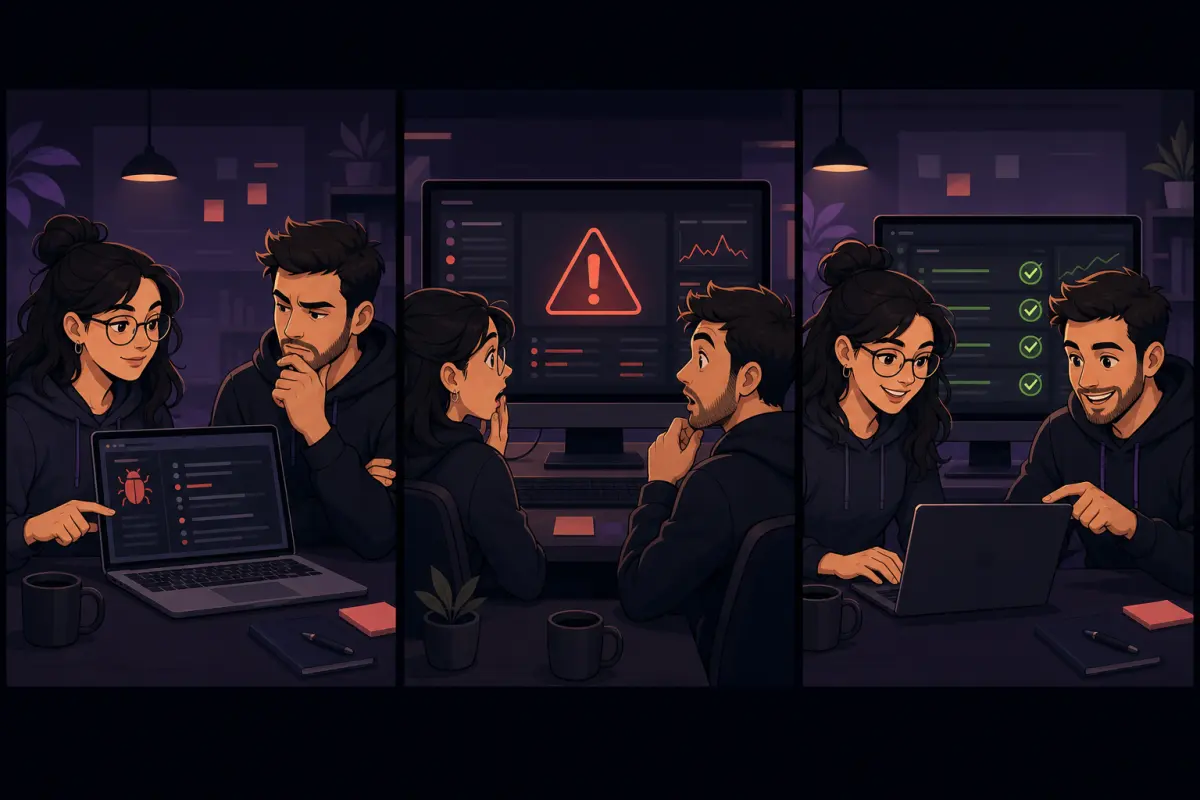
The conflict is familiar, but it is not inevitable
A software engineer finishes a feature and sends it to QA. The QA engineer finds a serious problem and returns it. The developer hears criticism. The tester hears resistance. A product discussion becomes a personal conflict.
This pattern can make QA and software engineers look like opponents. One person appears to create problems, while the other appears to block delivery. That interpretation is simple, emotional, and usually wrong.
Both roles should protect the same outcome. Users need software that solves the intended problem without creating unacceptable harm. The team also needs enough evidence to change that software safely.
Conflict often comes from the delivery system, not from either profession. Late testing, unclear ownership, poor testability, and deadline pressure create conditions where useful information feels like an attack.
Different perspectives make the product stronger
Software engineers know how the solution works. They understand the code, architecture, dependencies, and technical tradeoffs. This knowledge helps them prevent defects and diagnose failures quickly.
QA engineers examine the product through other models. They study user goals, business rules, state changes, permissions, integrations, environments, and failure recovery. They also look for assumptions that the implementation does not make visible.
Neither perspective is complete alone. Implementation knowledge can hide an assumption because the solution feels familiar. External investigation can miss an important constraint because the investigator cannot see the technical design.
A strong team combines both views. The developer explains the change and its technical risks. The QA engineer adds product risks, unusual conditions, and evidence needs. Their overlap creates better coverage than either person can create alone.
The handoff model turns colleagues into gatekeepers
The most damaging workflow is simple: developers build, testers test, and developers fix. Quality enters after the important design decisions are already difficult to change. Every finding then threatens a deadline.
This workflow rewards defensive behavior. Developers try to prove that the feature is finished. Testers try to prove that important defects still exist. Both sides protect their stage instead of improving the whole delivery flow.
A QA gate can sometimes be necessary, especially in regulated or high-risk work. However, a gate must not become the first serious quality conversation. A late gate detects problems after the team has paid most of the implementation cost.
Continuous delivery guidance treats testing as work across the delivery lifecycle, not as a separate phase after development. Early and continuous feedback makes defects easier to understand and reduces the pressure around final verification.
Shared ownership does not erase specialist roles
The phrase everyone owns quality is useful only when the team defines responsibilities. Without that clarity, it can mean that nobody owns test strategy, exploratory investigation, or release evidence.
Software engineers must test the code they create. Fast unit and component checks belong close to the implementation. Engineers must also design observable and controllable systems that other people can investigate.
QA engineers bring specialist testing judgment. They model risks, select test techniques, lead exploration, evaluate cross-system behavior, and explain uncertainty. They also help the team improve its test approach instead of becoming the only people allowed to test.
The current Scrum Guide makes the Developers accountable for creating a usable Increment that meets the Definition of Done. This accountability supports shared product responsibility. It does not remove the value of deep quality expertise.
Collaborate before the first line of code
The best time to prevent an expensive defect is before implementation. A short conversation between product, QA, and engineering can expose unclear rules, missing states, and unsafe assumptions.
Use concrete examples. Ask who can perform an action, what state must exist, what data changes, and what happens after interruption. Discuss permissions, duplicate requests, dependency failures, and recovery before they become hidden implementation choices.
The developer can identify technical constraints and propose testable boundaries. The QA engineer can identify important variations and evidence needs. Product can confirm which behavior creates value and which failure causes unacceptable harm.
This is not a meeting for writing every test case. It is a focused design activity. The goal is enough shared understanding to build the right behavior and make that behavior possible to verify.
Make bug conversations about evidence, not blame
A defect report can feel personal when it sounds like a judgment about the person who wrote the code. Avoid labels such as careless implementation or obvious bug. Report the observed behavior, expected behavior, conditions, evidence, and impact.
Developers should treat a report as new product information. Questions about reproduction or impact are valid when they improve the decision. They become harmful when they only defend the implementation or exhaust the reporter.
QA engineers should separate facts from interpretation. A failing request, incorrect balance, and reproducible data state are facts. A suspected race condition or release recommendation is an interpretation that the team can examine.
When evidence is incomplete, investigate together. A developer can add logs or trace state. A QA engineer can vary timing and data. Joint investigation is often faster than sending the issue back and forth through comments.
Build automation as shared engineering work
Automation creates another common conflict. A QA engineer may own a large end-to-end suite while developers ignore it. The suite becomes slow or unstable, and every failure starts a debate about whether the product or the test is wrong.
Place each check at the lowest useful level. Developers can protect functions, components, and service contracts near the code. QA engineers can help select meaningful risks and add focused workflow checks where several components must work together.
Treat test code with the same care as product code. Review it, name it clearly, keep failures diagnosable, and remove checks that no longer provide useful evidence. Microsoft guidance also recommends shared test infrastructure and code-owner responsibility for component testing.
A test failure must have an owner and a response. The team should not accept a permanently red pipeline or routine retries. Google reliability guidance notes that broken builds slow teams and make later failures harder to isolate.
Share the release decision and production learning
QA should not carry the release decision alone. Product risk, technical risk, operational readiness, and business timing belong to different people. The team needs one evidence-based conversation that makes these factors visible.
A useful release summary states what changed, which risks received attention, what evidence passed, what failed, and what remains uncertain. It also states the recommended action and any monitoring or rollback needs.
Testing cannot prove that a complex system has no defects. Google reliability guidance describes tests as evidence that reduces uncertainty after change. Monitoring and controlled rollout add evidence that pre-release environments cannot supply.
After release, developers and QA engineers should review incidents, support cases, and production signals together. An escaped defect is not proof that one role failed. It is material for improving design, checks, observability, and future decisions.
Create a working agreement for partnership
Start with five explicit agreements. Discuss important risks before implementation. Make developers responsible for testing their components. Give QA time and access for independent investigation. Keep automated feedback trustworthy. Share release evidence and production learning.
Define how the team reports and discusses defects. Agree on the minimum evidence, priority factors, and response expectations. Decide when a quick conversation is better than a long issue thread.
Review the agreement after a difficult release. Ask where information arrived too late, where ownership was unclear, and which signal failed to help. Change the workflow instead of assigning blame to a profession.
QA and software engineers are not natural enemies, and friendship is not the real requirement. They are partners with different expertise and one product. Respectful challenge, shared evidence, and clear ownership turn that partnership into reliable software.